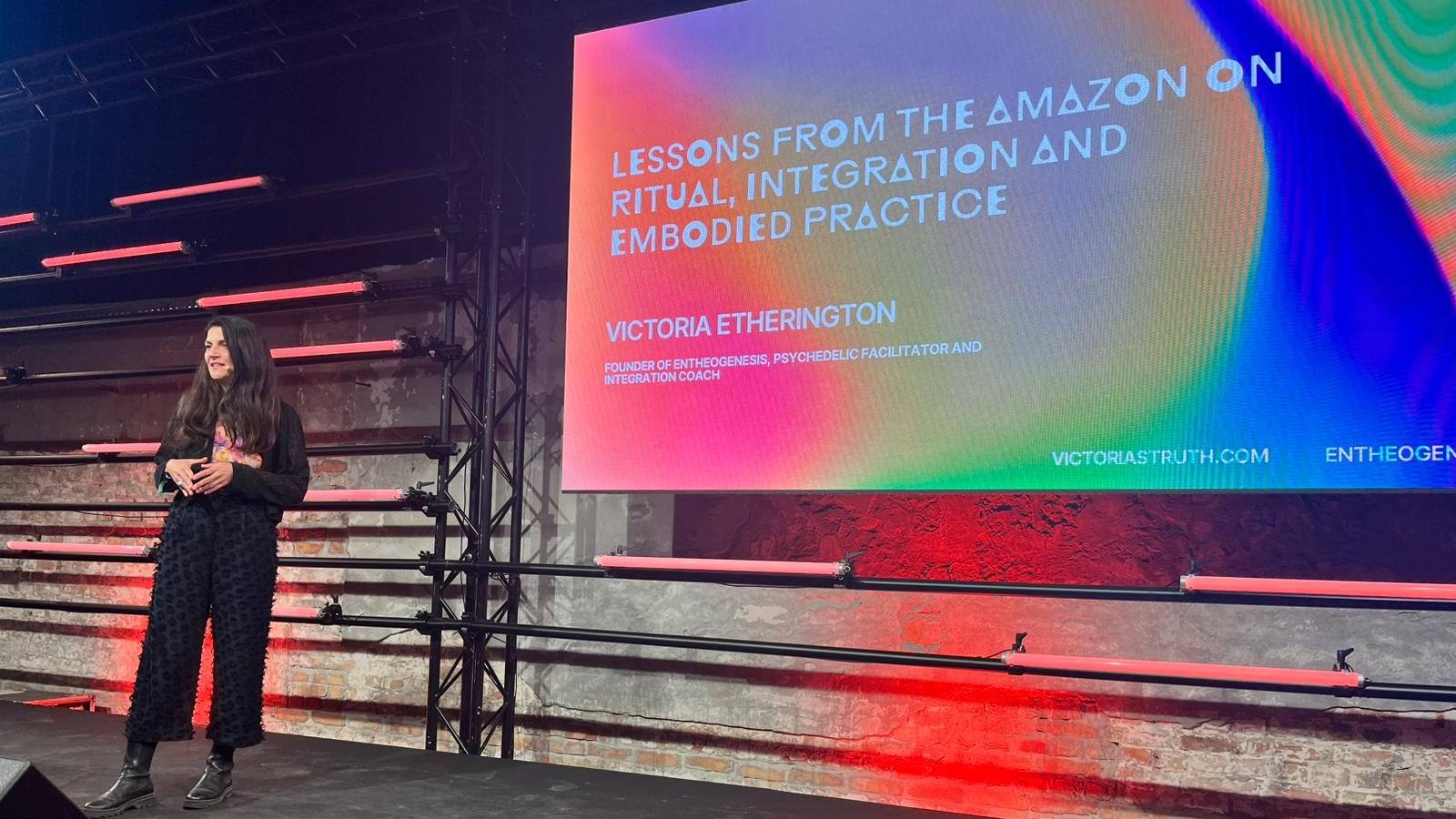
Before you read on, I’d like to invite you to do something with me. It’s how I opened my talk Lessons from the Amazon on ritual, integration and embodied practice at TRYP Expo (opens in a new tab) in Berlin on 17 May 2026, and it takes less than a minute.
Feel the ground beneath you. Your feet on the floor, the weight of your body in the chair. The earth is holding you up right now, as it always is.
Take one deep, conscious breath. This air has travelled a long way to be here. It has been breathed by forests and oceans, and it connects you to every living thing on this planet.
Notice any warmth in your body: your hands, your chest. There is a fire in you that has been burning since the moment you were born. That fire is your aliveness, your attention, your will to be here.
And water. Most of your body is water, the same water that moves through rivers, rain and tides. Water flows, finds its level and moves around obstacles. Let yourself be a little more like water for the next few minutes.
What you just did was not just an exercise. It was a ritual: four elements, a breath, a moment of arriving. People have opened important moments this way, in one form or another, for thousands of years. Because attention is a rare resource that can bring about transformation, and a ritual is a structure for focusing it.
Here is one question to hold while you read: when was the last time you were completely there? Fully present, in your body, in the room? That space of focus and presence is what rituals invite us into, and it’s what this article is about.
Five weeks in the Amazon
I want to take you somewhere first. Brazil, the Amazon, the state of Acre, deep in the western jungle near the Peruvian border. To get there you fly, then take a nine-hour car ride on a very bumpy road, followed by six hours up the river in a small boat. At some point, the world you know quietly disappears behind you.
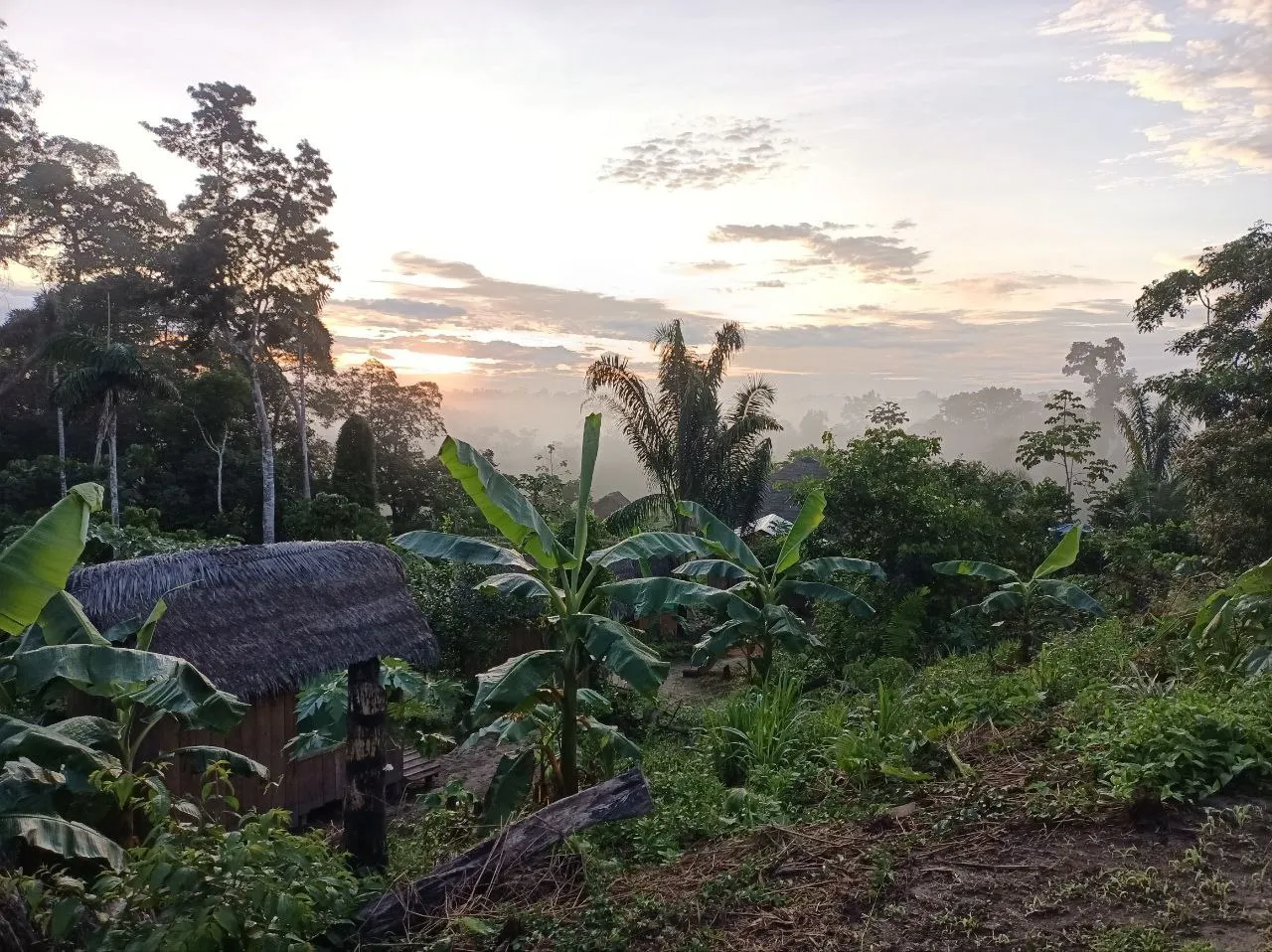
Morning mist over the forest in Acre.
I spent five weeks there on a dieta with the Yawanawá people. A dieta is a traditional practice of spiritual study. You live in the forest, eat very little, abstain from sweets and sex, and work with medicinal and sacred plants. And you show up, every single day, for prayer at dawn and at dusk.
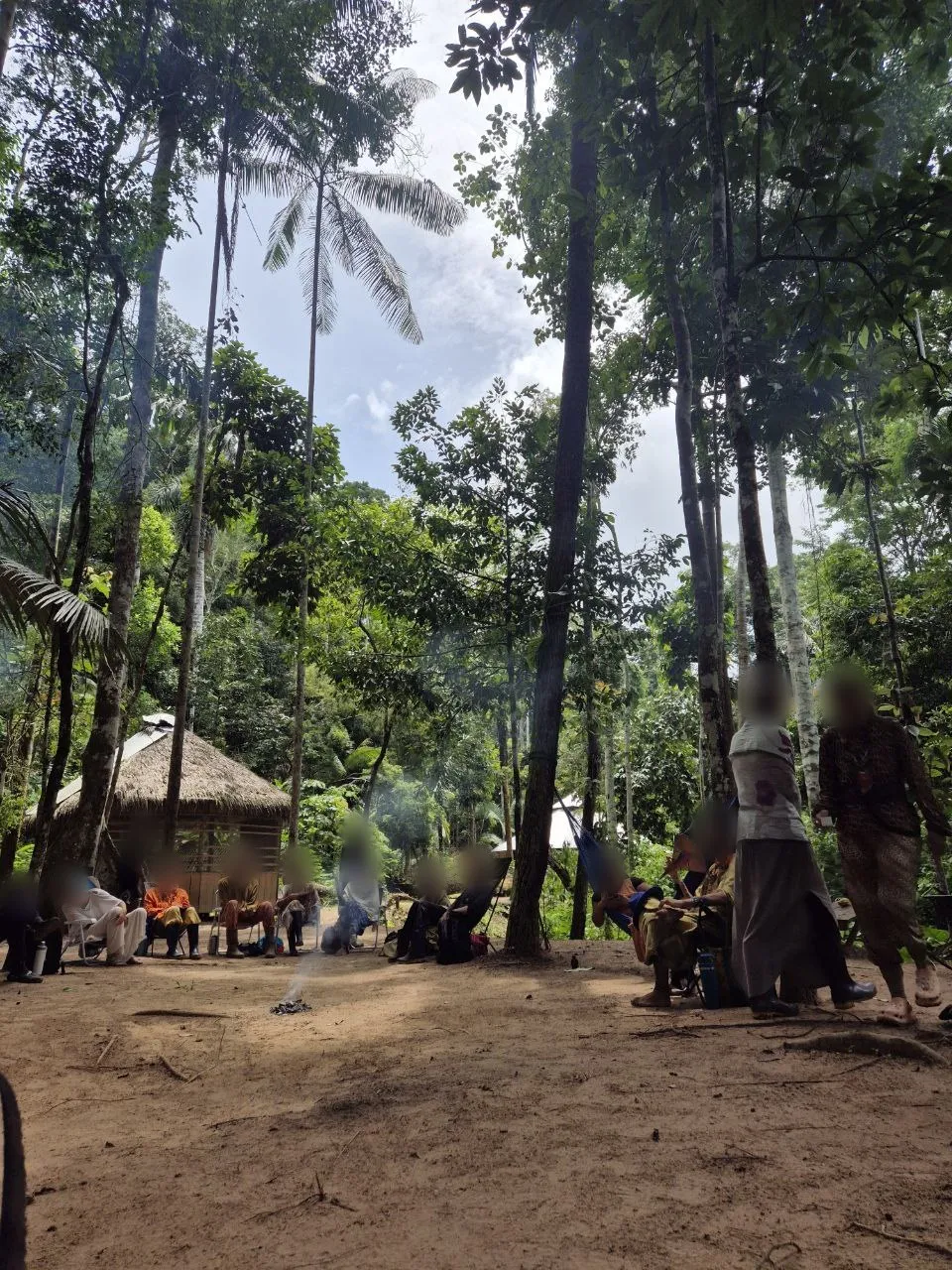
Gathering in a circle in the forest.
Those two daily prayers were one of the ways we created a container: a space that was held for the whole five weeks. Every morning at 5am, and every evening at sunset, each person sat with the fire to pray. The sepa, a beautifully scented tree sap, was lit and its smoke moved through the space. Then came the hapé (also known as rapé), a sacred tobacco snuff, blown through a pipe into each nostril: sharp, sudden and completely grounding. Immediately, you are here. You are nowhere else. And then the prayer, asking the plants, the forest and the medicine for protection, for support and for the courage to keep going.
The dieta had a proper beginning. In an opening ceremony with a special prayer called the seya, each of us spoke our intention, the thing we were asking to be transformed, into a pot held by one of the elders, and each person drank from that pot, witnessed by the group. What was private became shared; what was individual became collective. Five weeks later there was a closing ceremony, and we travelled back down the river to a familiar world, each of us changed in some way. The going-back was as deliberate as the going-in.
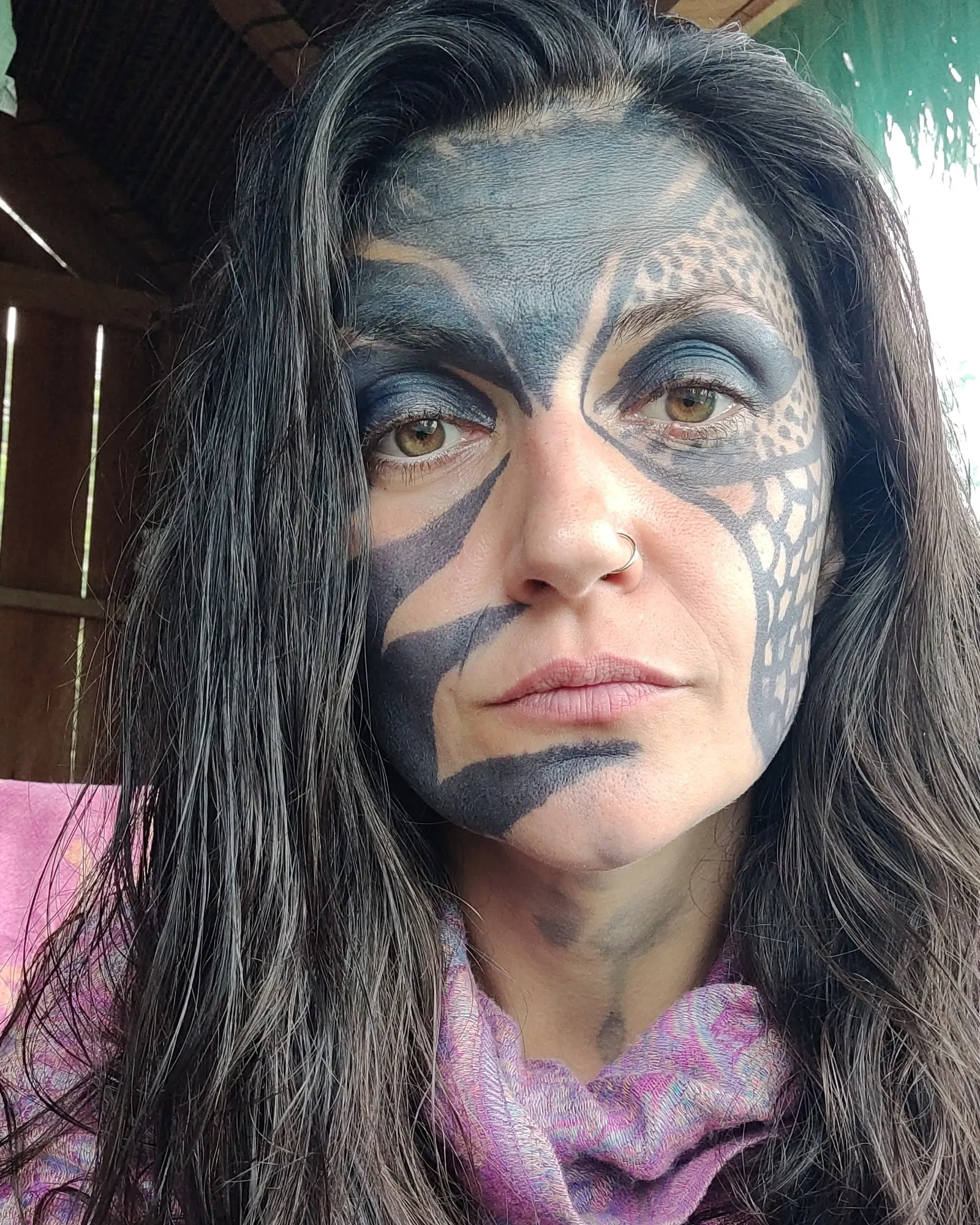
Face painting during the dieta.
I have been sitting with one question ever since: what were those rituals doing, those prayers every day, rain or heat, well or sick, whether we felt like it or not? The answer I keep finding is this: they were building a focused container.
What is a ritual?
“Ritual” is one of those words people either over-mystify or completely dismiss, so I want to strip it back. The definition that resonates most deeply with me, after years of working as an integration coach and psychedelic facilitator, is this:
A ritual is focused attention, held inside a structure.
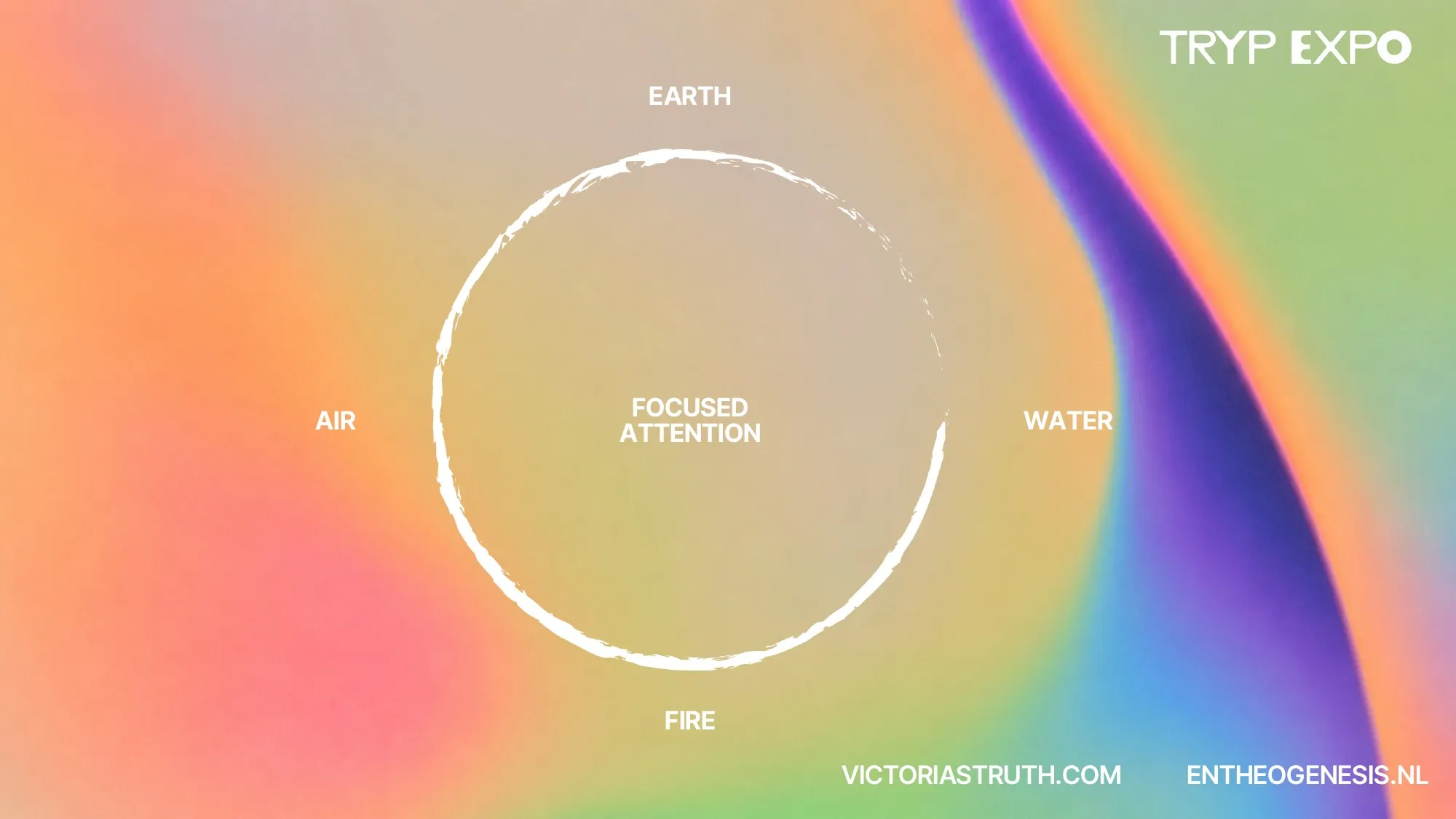
Focused attention at the centre, held by the four elements.
The key word is focused. It is what separates ritual from habit. A habit is something we do on autopilot: brushing your teeth, taking the same route to work. Habits are useful, but unconscious. The moment you bring deliberate attention and intention to an action, the moment you say this is for something, I am here for this, it stops being a habit and becomes a ritual.
Every human culture we know of has developed rituals for marking transitions, entering altered states and binding people together. That is not superstition or primitive thinking. It is the human species saying, again and again across thousands of years: we need these.
The anthropologist Arnold van Gennep mapped the structure of what he called rites of passage, and found the same three stages across cultures:
- Separation: you step out of ordinary life, and something marks that you have left.
- The liminal phase, from the Latin limen, threshold: you are no longer who you were, and not yet who you are becoming.
- Incorporation: you return, but you return changed.
Building on his work, the anthropologist Victor Turner noticed something remarkable about that middle phase. When people cross a threshold together, hierarchies dissolve. The professor and the cleaner are simply two people in a circle. Turner called this felt sense of shared humanity communitas, and saw it not as a side effect of ritual, but as what ritual is for.
Or, in the words of the philosopher Byung-Chul Han, ritual is “a technique of making oneself at home in the world”. Not a technique for getting somewhere better, but for arriving here, for landing in your own life.
The four elements of every ritual
When I asked you at the start to feel the earth, breathe the air, notice your fire and feel the water in you, I wasn’t just opening gently. I was showing you the map. I believe the four classical elements are a precise description of what every ritual is actually built from.
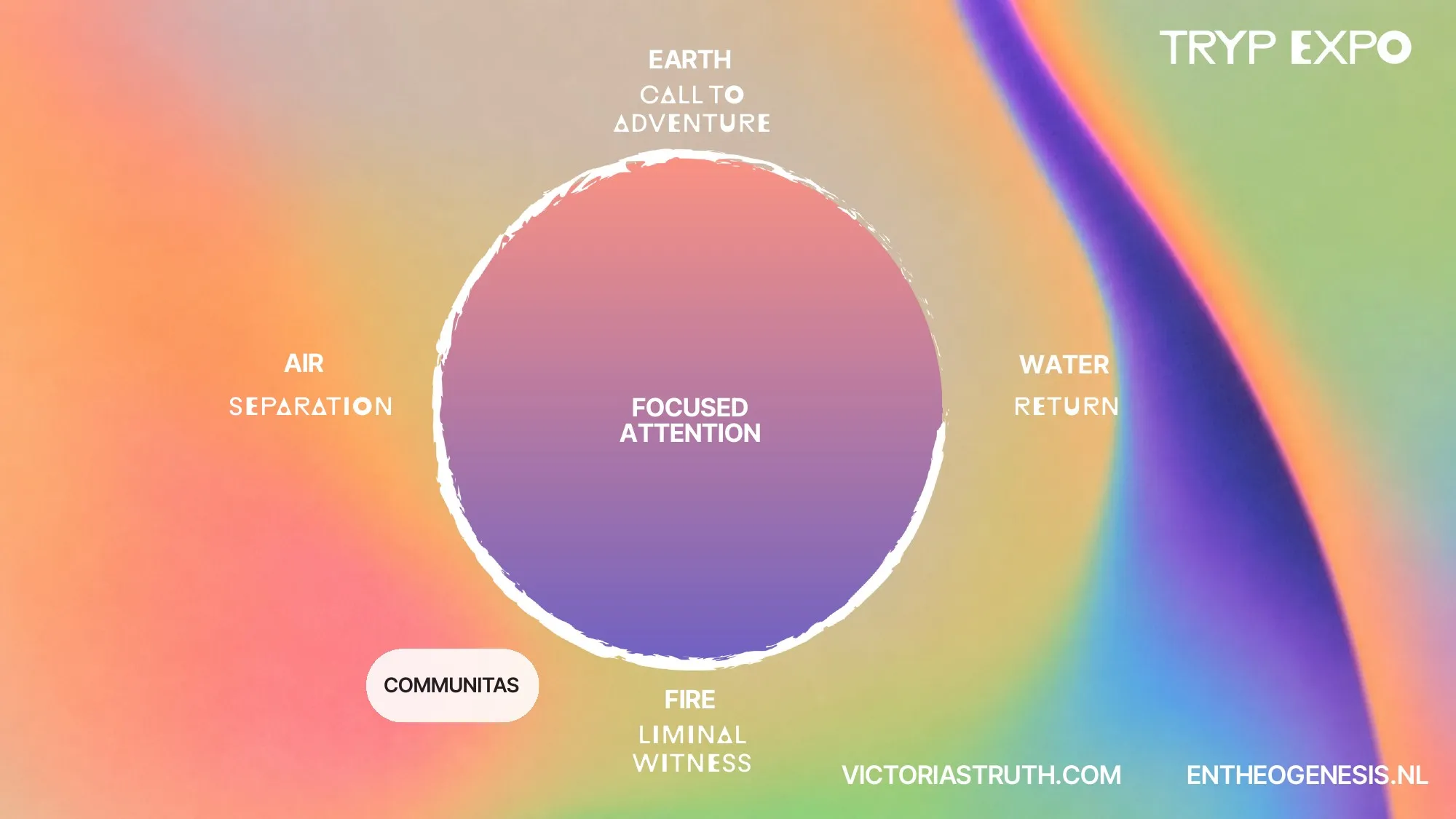
The ritual container, as I presented it at TRYP Expo: earth as the call to adventure, air as separation, fire as the liminal space and witness, water as the return.
Earth is intention
Earth is the ground you stand on. Before any ritual, ceremony, therapy session or medicine journey begins, you need to know why you are here.
In the Amazon, there was a period of preparation before the opening ceremony: quieting ordinary life, adjusting what we ate and consumed, and asking ourselves over and over, “what am I here for?”, so that our “why” could be spoken into the pot. In the guided retreats we run at Entheogenesis, intention is the first and most important piece of work we do with every participant. The quality of your intention shapes the quality of your experience. In Joseph Campbell’s Hero’s Journey, too, the journey doesn’t begin with the quest. It begins with the call: what is being asked of me? What needs to change?
Intention is the earth beneath your feet: the difference between wandering around and walking somewhere.
Air is the threshold
Air moves and crosses boundaries. You can feel the air change when you step into a different space, and the threshold in a ritual is exactly that: the moment something shifts.
In the Amazon opening ceremony, the threshold was unmistakable. Everyone gathered, the seya prayer was spoken, each intention was breathed into the pot from which we drank, and you knew, in your body and not just your mind, that you had crossed. In a wedding, it’s the walk down the aisle; at a graduation, crossing the stage. Something marks that ordinary time is behind you. And when people cross that threshold together, the communitas Turner described arrives: that felt equality and sudden openness. Anyone who has sat in a genuine ceremony or a real group circle knows exactly what I mean.
Fire is witness
Fire gives light and makes things visible. The third element of every ritual is the act of being seen.
Even a private practice, such as a morning ritual, journaling or meditation, asks you to be a witness to yourself: present, not drifting, turned towards your own experience with warm, steady attention. But the most transformative rituals are witnessed by others. Something happens when another human truly sees you: not the edited or professional version, but you, uncertain, searching, in process. In ceremony, we sit with one another through the full arc of the experience. That sustained, non-judgemental presence, what Carl Rogers called unconditional positive regard, is itself a form of medicine. The participant knows: whatever happens, I am held.
Water is release
Water flows and always finds its way to the sea. The final element is the one we most often forget or skip: the release, the closing, the return. Every container that is opened must be closed, and the ending needs to be as intentional as the beginning.
At the close of a ceremony in some Amazonian traditions, the facilitator moves through the room with the chakapa, a rattle made of leaves, sweeping and cleansing (limpiar). The songs stop, silence falls, and people are gently brought back rather than thrown back.
At Entheogenesis, we have a practice I love for this. At the beginning of every ceremony, each participant lights their own candle, which burns alongside them in the centre of the room. At the close, each person extinguishes their own candle, signalling the ending. Then they take it home, and are encouraged to light it again during their integration: a micro-ritual that connects them to everyone else lighting theirs, wherever they are. The nervous system remembers: when this flame is lit, I am present, I am doing my work. The ritual becomes its own portable container.
Without a closing, a container can become a cage. Turner described it as permanent liminality: stuck between and betwixt. We see this in people who have had profound experiences, through trauma, psychedelics or major life transitions, without a structure to close the arc. They remain in limbo. The water never reaches the sea.
What happens when we lose our rituals
Byung-Chul Han describes modern life as “the hell of the same”: an endless scroll of content, novelty and stimulation, with no depth, no recurrence and no structure for making meaning. We are a deeply connected, information-saturated generation, and yet loneliness and anxiety are widespread. Something structural is missing that more information, more apps and more content cannot fix. I think what is missing is the container.
We have lost many of our collective rituals of transition. What do we offer a young person crossing into adulthood? Exams, perhaps a party, but rarely a moment where the community gathers and says: we see you, you belong here differently now. What do we offer someone who is grieving? A short leave, a funeral that lasts an hour, and then back to work. But grief is a liminal process. It needs time, witness and structure to move through; without them, people carry it for years.
The anthropologist Bronisław Malinowski wrote that ritual gives people stability in times of uncertainty, like “locking onto a set of cosmic coordinates”. I love that phrase, because it describes so many of the people who come to ceremonies and retreats. They are not broken. They are unmoored. They have lost their coordinates, and what they are looking for, often without knowing how to name it, is a way to find them again.
That is also why I believe so many people are drawn to psychedelic ceremonies right now. In my experience it’s rarely primarily about the substance. Underneath the questions about healing, growth or expansion, people are searching for a safe container in which to transform something in their lives. They want earth: a clear intention. Air: a threshold, a before and after. Fire: to be witnessed and not alone. And water: a safe return, a way to bring what they found back into their lives. The substance matters, but the ritual is what makes it work. “Set and setting”, which we talk about endlessly in the psychedelic world, is simply another way of saying: the ritual container.
How to build your own ritual
We don’t need to copy old rituals. We can understand what they were for, and build new ones that serve us now. The structure is transferable, and you need four things:
- Earth, an intention: What is this for? What am I bringing to this moment?
- Air, a threshold: something that marks the beginning. A breath, a candle, a phrase, a particular doorway, putting your phone face down: anything that says ordinary time has paused, I am here for this.
- Fire, a witness: even if it’s just you, watching yourself honestly. Whenever possible, a person who holds the space with you and doesn’t look away.
- Water, a release: something that closes the arc and says this is complete, I bring what I found back with me.
Applied with intention, these four can turn almost anything, whether a morning practice, a coaching session, a celebration or a creative process, from routine into something that can actually move and change you.
This is at the heart of my coaching work. In one-to-one integration coaching, I help people find where the containers in their lives are broken or missing, and rebuild them. In ceremony, we build the container together, hold it together and close it together.
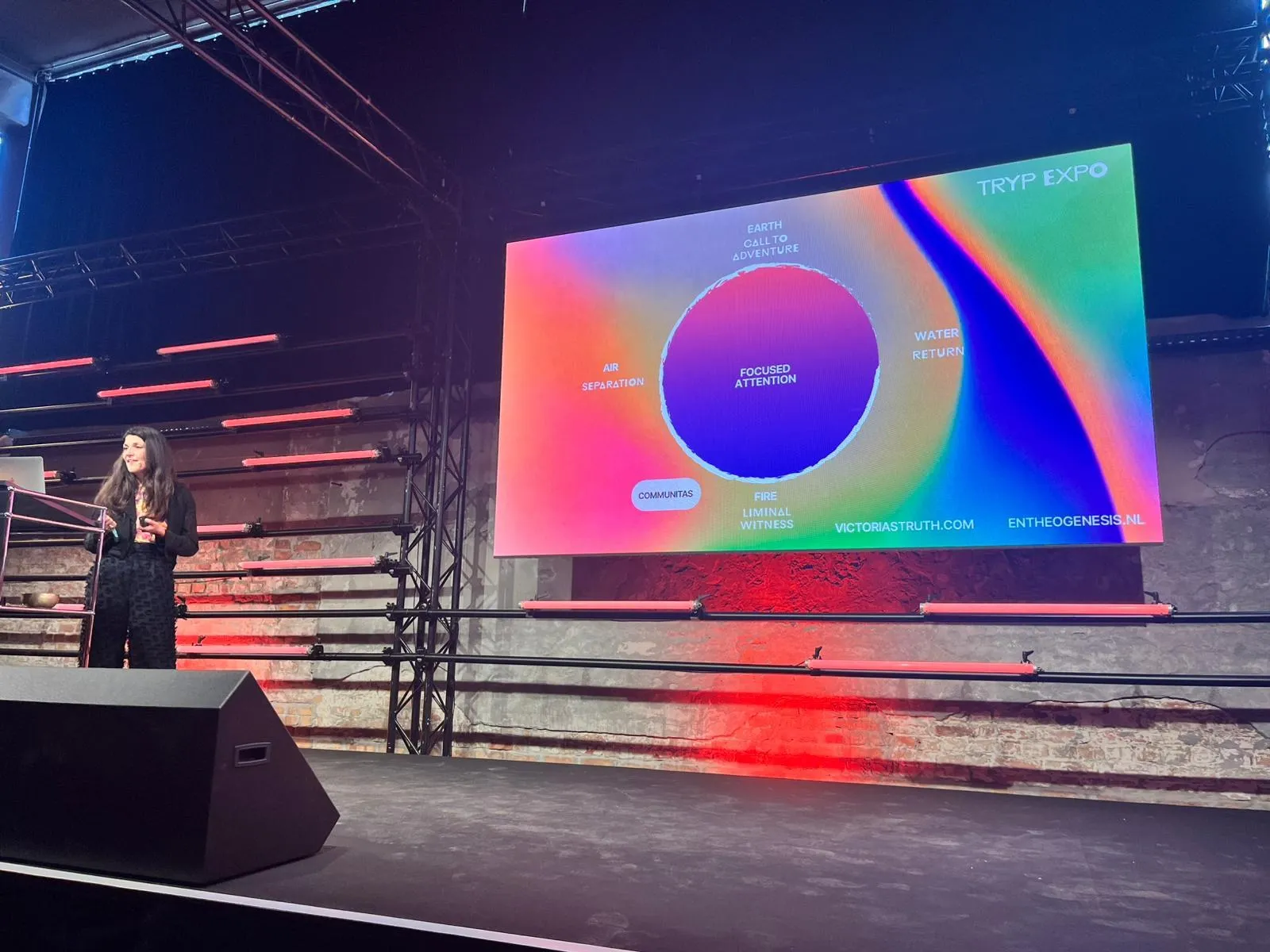
Presenting the ritual container at TRYP Expo, Berlin, May 2026.
Ritual is not a relic. It is a fundamental human need, as fundamental as food, sleep and connection. When we don’t have it, we don’t stop looking for it; we just look in stranger and stranger places. Better to know what we are looking for, and how to build it.
Earth, air, fire, water. Intention, threshold, witness, release. Four elements, one container.